
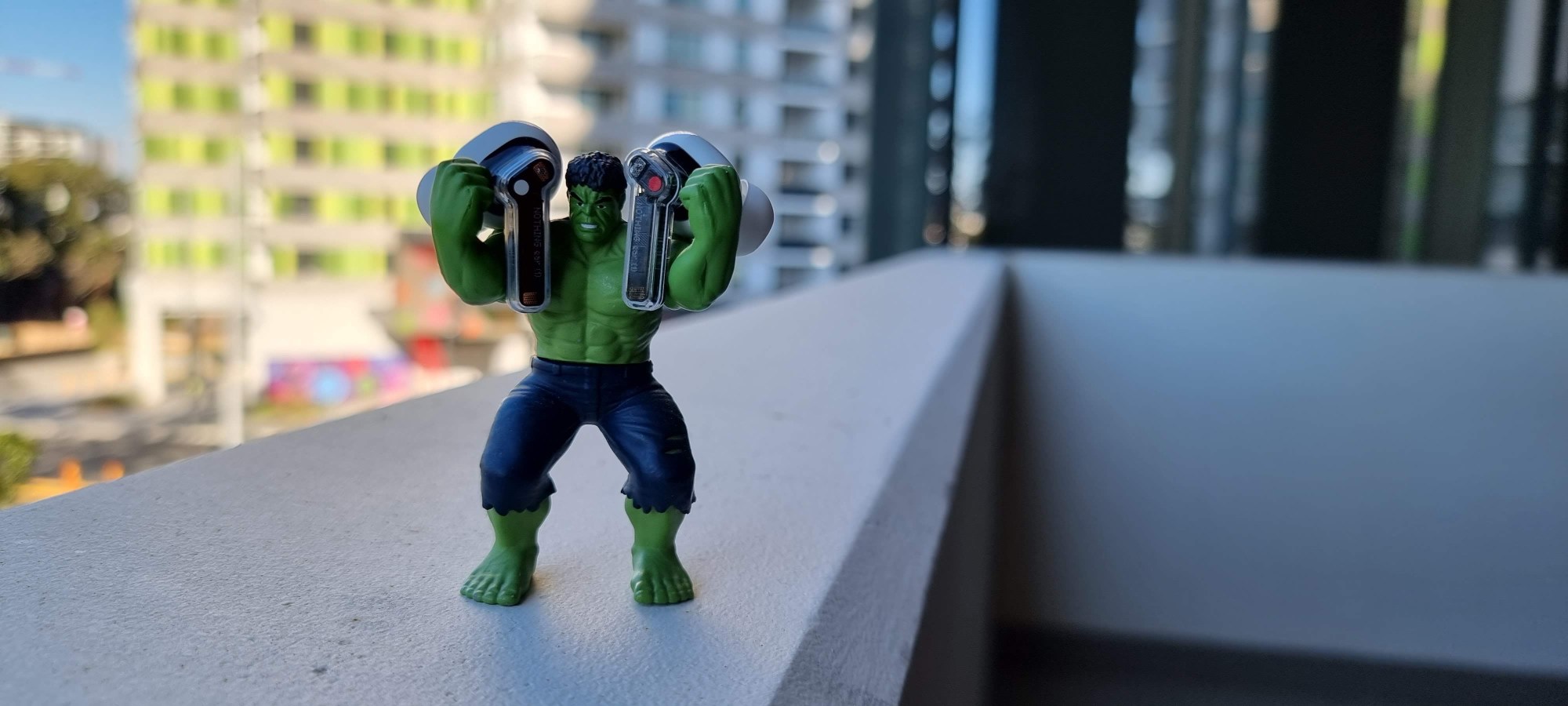
People will usually not expect a lot from the first product of a tech company. However, Carl Pei’s Nothing didn’t give us an option not to expect a lot from Ear (1). Honestly, the hype was so much around the tech community that people tried to place an order in 4 instances and still missed the chance. Carl Pei is an expert in creating hype; he did the same with OnePlus and created the brand it is today. Apart from Carl Pei, Nothing is also backed with investment from GV, Tony Fadell, and influential creators like Casey Neistat. But leaving all that aside, I was more excited about the design of the product than the features. I did not expect a lot from a $99/A$149 pair of true wireless earphones. That definitely helped me in enjoying the product a lot more; as MKBHD puts it, “expectations are the thief of joy.”
Design


The most notable and also the most striking thing of Nothing Ear (1) is the design. Transparency is at the heart of the design; Ear (1) has a clear stem that lets you peek into the internal components along with the transparent(almost) charging case that can keep the buds in view at all times. The design is truly unique. However, Carl Pei said in the keynote that he wants Nothing’s products to blend in with the world. Although the Nothing Ear (1) doesn’t in any way blend in with the world, it definitely stands out and is a great branding strategy for the company. I love the design, and as I said before, that is one of the main reasons I decided to buy them. The engineers of the company did a commendable job in making the transparency look so good. If you tear apart any of the other TWS earphones in the market, you’ll know how horrible they look. The glue is everywhere, and parts generally look cheap. That is most certainly not the case with the Nothing Ear (1). I am honestly awestruck by the pure thought and beauty of this fantastic product.
Like all transparent tech, the Ear 1s are fun to explore up close. On the outward-facing part of the stem, you can see the voice / ANC microphones, touch sensors, and a dot — red (right) or white (left) — to indicate which ear that bud is for. On the side facing your ear, there’s some circuitry, magnets, and the pins where the earbuds connect to the charging case.
Sound Quality
In terms of sound, the Ear (1)s have 11.6-millimetre drivers that don’t pull off any huge upsets against more premium competition. But they also don’t sound bad. The earbuds definitely have some(ignorable) weaknesses that earbud enthusiasts will pick up on. But honestly, at this price, they are probably the best sounding earphones out there. Unless you go for the Sony Wf-1000XM4 or the Bose TWS earphones that are 3 times the price, you will not be able to notice a significant difference. Even though the galaxy buds pro sounds better in general, they are not drastically better for an average consumer to see daily. I would definitely suggest these to anyone that just wants to listen to podcasts, songs or watch movies and are not an audiophile.
Battery Life

Since Nothing prioritized a lightweight design, the ear (1) don’t really measure up to their rivals in terms of battery life. However, each earbud houses a 31mAh battery that lasts up to four and a half hours on a full charge, and the case has a 570mAh battery that’s good for charging both ‘buds six times over. So with the case fully charged up, you’re looking at around 24 hours of music playback with the noise isolation enabled and 34 hours without ANC. I feel that is pretty good considering the transparent design that was evidently given priority to.
My Battery stats across 72 hours dropped from 100%-20% with ANC on, and my usage was something like this:
Podcast – 4.5 hours
Audiobook – 1 hour
Call Of Duty Mobile – 4 hours
Netflix – 3.5 hours
Video calls – 4 hours
The battery is not terrible. I get a much worse battery on my AirPods Pro, but the Nothing Ear (1) is not as good as the Galaxy buds pro or Galaxy Buds Live.
The addition of USB-C and wireless charging definitely adds to the battery and charging experience. The Nothing Ear (1) also have fast charging, capable of charging the buds for 50 minutes worth of music playback with a 10-minute wired charge. In addition, the case battery adds six hours worth of charge in the same time when plugged via a USB-C cable. The buds also have wireless charging, a feature that you don’t usually get in this segment. The case can charge at up to 5W using the Qi wireless standard. And just like with Samsung’s Galaxy Buds series, you can use a phone with reverse wireless charging like the Galaxy S21, Fold 3, Flip 3 or the OnePlus 9 Pro to charge the Ear (1) wirelessly.
Connection

The Ear (1) connect over Bluetooth 5.2, and they deliver rock-solid connectivity. I never had any static issue, and even minor issue of disconnecting for a second (that happens on literally all TWS earbuds) was scarce. However, the issue I faced was when I had to switch between connected devices. For instance, I have the Ear (1) connected to my Fold 2 and want to switch to the iPad. So I would go to Bluetooth with other earbuds and then click on the earbuds name in the device settings. When I try to do the same thing with the Nothing Ear, (1) one of the three things happen; 1) it just wouldn’t connect, 2) it takes over 10 seconds to switch, and 3) it switches immediately without any issue. It was a 50-50 split between getting connected and not getting connected. I had to do a reset, and now it works 80% off the time. If it doesn’t connect, I have to turn Bluetooth on/off and try. If it still didn’t work, I had to disconnect from the connected device and connect.
Features


The earbuds are also IPX4 sweat and water-resistant, so they can be used for workouts. I haven’t tested these for workouts yet, but I wore them while doing chores around the house and didn’t lose connectivity. The app allows you to customize gestures, view the battery level for each earbud, update the firmware, and more. There’s also a nifty Find My Earbud feature that produces a loud tone to make it easy to locate a missing earbud.
The Nothing Ear (1)’s also include auto-pause/play, so whatever you are listening to automatically stops and resumes when you remove or put them back in your ears.
You can also customize the touch gestures using the app. At the moment, you only get the ability to set gestures for a triple tap and a long tap. By default, a double-tap gesture is used for playing or pausing music, and you can adjust the volume by swiping up and down the length of the stem. Unfortunately, there is no way to trigger Google Assistant, Alexa or Siri.
The standout feature that is very rarely found in this price range is active noise cancellation. Or rather, good active noise cancellation.
Active Noise Cancellation and Transparency
There are two levels of active noise cancellation — Light and Maximum. The earbuds do a great job tuning out ambient noise, including the hum of an air conditioner or fan. It’s not quite as effective for loud sounds, but you will see some gains with the mode enabled. Nothing has also included a transparency mode, which does an excellent job of letting everything in so you can speak to someone briefly or listen for traffic.
Comfort
The Nothing Ear (1) has a snug, secure fit that is made even better by how light they are. At only 4.7g per earbud, the Nothing Ear (1) are one of the most comfortable pair of true wireless earphones I have ever tried. Moreover, it is genuinely comfortable to wear for long periods, which I cannot say for many other earphones.
Value
At $99/A$149, the Ear (1)s include active noise cancellation, wireless charging, IPX4 water resistance, and more minor conveniences like in-ear detection — features that cost anywhere from $150 to $300 from Nothing’s big brand competitors. Teenage Engineering has tuned their sound, a company well versed in audio electronics.
Overall, based on my experience, I would suggest Nothing Ear (1), considering its price and value. Having ANC, good sound quality, reliable connection and a truly unique and stunning design at that price outweigh the minor inconveniences and bugs, in my opinion.
 TechAware